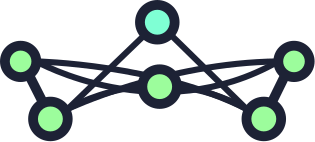
A reader does not consume a body of knowledge. They consume one piece at a time, usually out of order, usually alone. When that piece arrives with no connection to what came before it and no path to what comes next, it becomes an orphan: correct, valuable, and unusable. This "Orphaned Knowledge" is the mirror image of the Rigor Penalty, not a failure of the creator to close the loop, but a failure of the system to give each piece a home. By treating content as a navigable structure rather than a stream of isolated posts, the physician ensures that good work survives the moment it is read, instead of dying as soon as the feed scrolls past it.
Isolation at the Point of Use
Misinformation is rarely consumed in isolation. It arrives as a system, a worldview with a vocabulary, a set of villains, and a next step that always points back to more of itself. Every piece reinforces every other piece. The reader who accepts one is handed a map to the rest.
Rigorous medical content arrives the opposite way. A clinician publishes an excellent analysis of iron absorption. A reader finds it, understands it, and leaves. Three weeks later, standing in a kitchen, they cannot retrieve it, cannot connect it to the supplement they just bought, and cannot reconstruct the part that actually applied to them. The piece was accurate. It was also an orphan, with no parent to give it context and no siblings to extend it. The knowledge did not fail because it was wrong. It failed because it had nowhere to live.
Severed Lineage
The Orphaned Knowledge problem stems directly from how distribution works. Platforms reward the individual post, not the connected body. The clinician is conditioned to think in units, this article, this video, this thread, each one built to stand alone and, as a result, each one stranded alone. Production and connection are independent variables. You can produce a flawless piece and still orphan it the instant you publish it without a structure to receive it.
Misinformation creators do not make this mistake. Their content is natively connected, because the worldview does the connecting for them. The reader never encounters a fragment; they encounter an entry point. That sense of a coherent, navigable whole, not the accuracy of any single claim, is what earns trust and retention. Clinicians must recognize that the quality of a piece and the survivability of the knowledge are not the same problem.
Connective Architecture
Solving Orphaned Knowledge requires building the structure that adopts each piece. Every published unit needs a parent, the larger question it answers, siblings, the adjacent pieces that complete it, and a retrievable address: a permanent, findable home the reader can return to.
This is the second half of the Golden Rule. The Rigor Penalty is solved when a piece can be applied alone; Orphaned Knowledge is solved when that same piece is also a door to the system behind it. A post on heme versus non-heme iron should resolve the immediate question and, in the same motion, reveal that it belongs to a navigable body on absorption, deficiency, and supplementation that the reader can walk at will.
This body is the Atlas, the opposite of orphaned knowledge. It is not more content. It is the connective tissue that turns scattered correct pieces into a structure a reader can navigate, return to, and build on.
Accuracy keeps a single piece alive for a single moment. Architecture is what keeps the knowledge alive after the reader has closed the tab. Your responsibility does not end when the piece is correct. It ends when the piece has a home.